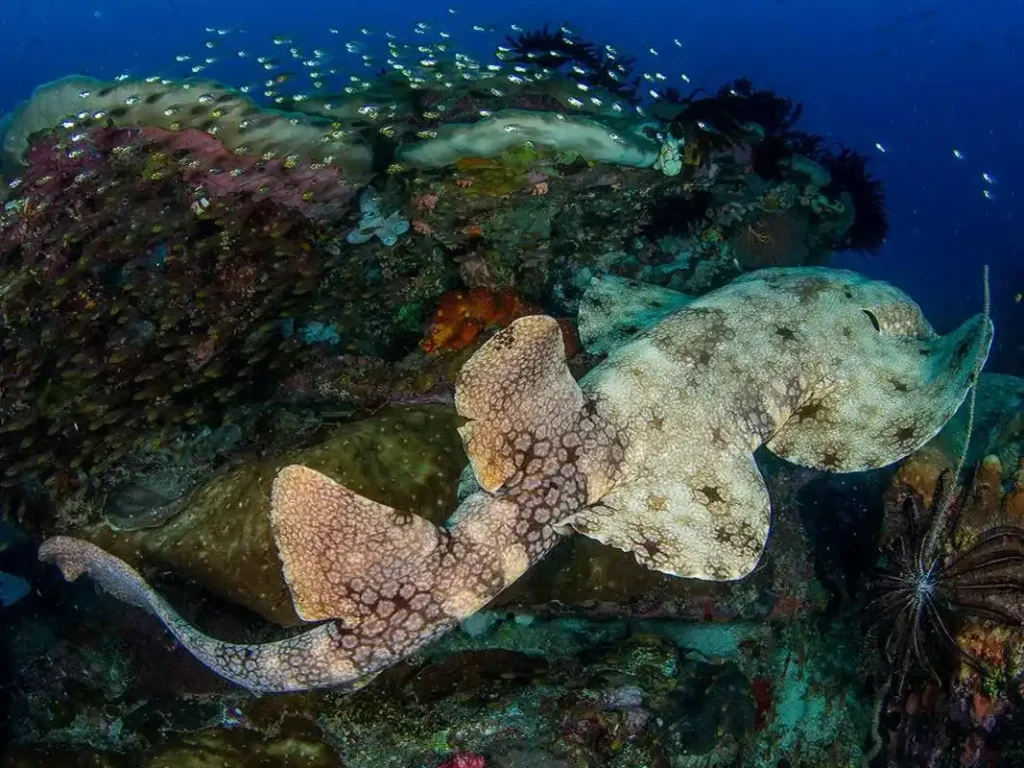
Castle Rock is the more demanding of the two: current rated 5 out of 5, negative entry, reef hook essential, Advanced plus 30 to 50 logged dives. Crystal Rock sits nearby at 4 to 5 out of 5 with clearer water and a shallower summit. If you dive only one, dive Castle Rock at slack and build up to it.
Side by side
Castle Rock and Crystal Rock compared
Castle Rock
Crystal Rock
Depth
4 to 30 m (working envelope 15 to 40 m)
5 to 35 m
Current
Very strong, 5 of 5
Strong, 4 to 5 of 5
Level
Advanced only — AOW plus roughly 30 to 50 dives
Advanced — AOW plus roughly 30 dives
Entry
Negative entry, no exceptions
Negative entry
Reef hook
Essential
Useful
Signature sight
Grey reef and whitetip sharks in numbers, giant trevally, dogtooth tuna, barracuda schooling
Clear water over a pinnacle summit, sharks, eagle rays, soft coral
Best for
Big-animal action at the top of your ability
The same neighbourhood with a slightly wider margin
They sit close enough that a single morning can take in both, and boats often run them back to back when the tide is right. That is the ideal introduction: Crystal Rock first to calibrate, Castle Rock second with the current now understood.
What makes Castle Rock hard
Castle Rock is a submerged seamount in open water at the northern end of the park. There is no island shelter, so the current arrives with nothing to break it. The dive works like this: negative entry timed to put you on the upstream face, immediate descent, hook in on the exposed side, and hang. You are a spectator on a rope while the ocean runs past, and the sharks patrol the current line in front of you.
Everything that makes it spectacular is the same thing that makes it unforgiving. Miss the drop and you are in blue water above a seamount with no reference. Lose the hook and you are downstream in seconds. Ascend without a plan and the boat is looking for a diver in open ocean rather than beside a reef. Which is why the certification bar — Advanced plus 30 to 50 logged dives — is not negotiable at a serious operation.
Why Crystal Rock is the better first pinnacle
Crystal Rock’s summit rises to around five metres, which does two things. It gives you a shallow refuge to finish the dive over, and it means part of the structure breaks the current, so there is a lee to work from in a way that Castle Rock’s exposed top does not offer. The water is also, as the name suggests, usually clearer — the northern sites run 15 to 30 metres of visibility, and Crystal Rock tends to sit at the top of that band.
You still need Advanced, a negative entry and around 30 logged dives. It is not an easy site. It is a site where a competent Advanced diver has margin, which Castle Rock does not always give you.
Timing: the variable that decides everything
Both sites are tidal. Slack and the first stage of a building current give you the classic dive: sharks in the flow, visibility open, hook holding without strain. Two hours into a full run you are in a wind tunnel, and the good divers are the ones who called it before they got in. Northern Komodo water sits at 27 to 29 °C from November to April and 26 to 28 °C from May to October, so exposure is comfortable in a 3 mm suit; cold is not what limits the dive here, current is.
The practical planning consequence: pinnacle dives get the first slot of the day, and the whole schedule shifts around them. If your boat is putting Castle Rock at 14:30 because that is when the itinerary printed it, ask why.
Gear that matters on both
Reef hook and a metre of line. Non-negotiable on Castle Rock, useful on Crystal Rock. Hook into dead rock, never coral.
SMB and a spool, long enough for a 20-metre deployment, carried by every diver rather than by the guide.
A computer you can read at a glance, because you will be watching gas and depth while holding position.
Gloves. Contentious in some destinations, standard on Komodo pinnacles where you are handling rock.
Fins with real drive. Split fins are a poor choice here.
If you are not ready yet
Build up on the same trip. Siaba Besar as a check dive, Tatawa Besar for an easy drift, Karang Makassar for a gentle drift with mantas, Batu Bolong once you have shown you can hold position in current. That progression is exactly how a well-run charter sequences a mixed-ability group, and it means the pinnacles come at the end of the week rather than at the start.
Frequently asked questions
Is Castle Rock harder than Crystal Rock?
Yes. Castle Rock is rated 5 out of 5 for current with no island shelter and requires a reef hook, while Crystal Rock sits at 4 to 5 with a summit around five metres that offers a shallow refuge and partial lee.
What certification do I need for Castle Rock in Komodo?
Advanced Open Water plus roughly 30 to 50 logged dives, comfort with a negative entry and experience using a reef hook. It is not a site to attempt on the strength of a certification card alone.
Do I need a reef hook in Komodo?
On Castle Rock, yes. It is useful on Crystal Rock and on Batu Bolong too. Hook into dead rock rather than living coral, and carry about a metre of line.
What sharks are at Castle Rock?
Grey reef sharks and whitetip reef sharks in numbers, patrolling the current line, alongside giant trevally, dogtooth tuna and schooling barracuda.
When is the best time of day to dive Castle Rock?
Slack water or the first stage of a building current, which usually means the first dive slot of the day. A well-run charter builds the whole day’s schedule around the pinnacle’s tide window rather than around a printed timetable.
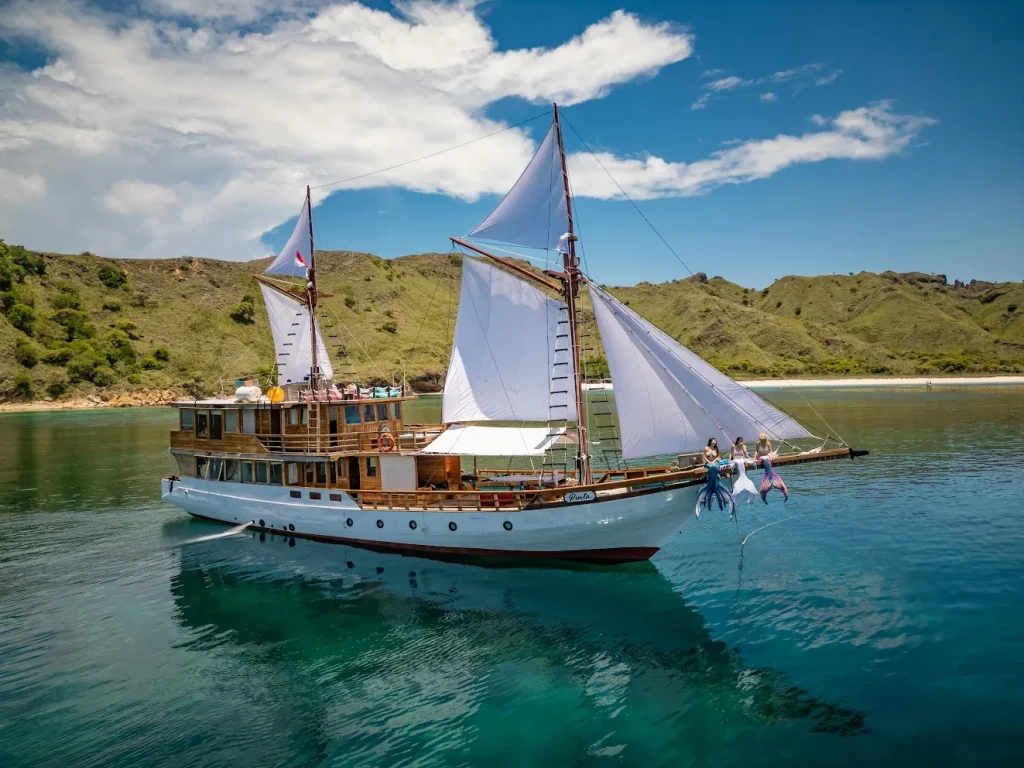
Pinta is operated and sold by Komodo Luxury, the Labuan Bajo charter operator running trips in Komodo National Park since 2015. Reservations, dive-team questions and date holds: WhatsApp +62 811 3823 875 or sales@komodoluxury.com.
Share this
Sailing This Season?
Send your dates and we will check the calendar before you book anything.

 Komodo Diving Guides